The Next Revolutionary is a Community
BACK TO BLOG
An edited version of this essay was published in Geese Magazine on July 10th, 2026. Click here to read it!
There are two major problems on the left. The first problem is that most people don’t subscribe to my specific ideology, and so they have a tendency to engage in treacherous, liberal, and counter-revolutionary acts that make organizing with them impossible. The second problem on the left is sectarianism.
I think it’s fair to say that the left’s ideas are popular, even if many people are afraid to pledge allegiance to our cause. Our handful of true allies in the electoral realm are proving the popularity of these ideas, even if they face uphill battles in actually implementing their policy programs. You can strip these ideas of their ideological trappings, explain them to liberals, moderates, and even conservatives, and find that most people will agree. As long as they’re not wealthy. This is encouraging.
But for every organization, union, or (dare I say) politician doing the work to promote a progressive program, there are a thousand keyboard warriors criticizing their failures, their compromises, and their inability to conform to an impossible ideal of right action. For every revolutionary optimist, there is a room full of nihilistic, pessimistic, or cynical critics. And far too often, these differences turn into arguments that pit us against people who could (and should) be our allies.
Even though the left has incredibly advanced and well-articulated theories to explain and justify our ideas, that matters less than the fact that the left doesn’t always seem like a nice place to be. People on the outside see a left filled with angry and exhausted people. They see petty squabbles and apocalyptic rhetoric. They see a dogmatism reminiscent of fascists and evangelicals. Many people reject the left without thinking about our ideas, instead relying on the cold calculus of a vibe check.
This is a problem for movement building. Our infighting is unattractive, and overshadows the impressive organizations we are building. Our dissatisfaction with the status quo is uninspiring, because our criticisms so often overshadow the solutions that motivate us. One of the biggest barriers to movement building is aesthetic, a result of the simple fact that to people on the outside, the left does not seem like a fun place to be.
But organizing shouldn’t have to be fun, it’s a necessity, a matter of survival in this critical moment! This is true, but I don’t think that’s a realistic or useful assertion. A mass movement requires masses, and when the masses look to us they see anger and exhaustion. Regular folk are perfectly aware of the rot pervading late-stage capitalism, because they experience it on a near daily basis. When faced with these issues, and faced with two opposing radical political movements (republican fascism and leftist socialism), they have a choice to make: do I align with one of these movements full of strange and miserable people, or do I decide that the system is irrevocably broken and focus my attention on what brings me joy?
What a tough choice. If it weren’t for the fact that so many people’s experience of systemic oppression prevents them from ignoring our political reality, the radical left would likely be depopulated. And if it weren’t for patriarchy’s tendency to alienate men from each other and themselves, the far-right would be similarly vacant.
The left could just as easily become a place that is alive with energy and joy (and many parts of the left already are). It could become the natural home of working class social life. It could become a space that inspires people to become more compassionate, more caring, more community-oriented, and more in-tune with nature. But the left will not change until the people in it let their politics change them. And the left will not grow unless joining our ranks feels like an irresistible invitation.
Anti-Sectarian Organizing
When I came back to organizing, I made a conscious decision to avoid labeling myself. I decided that it would be more productive to focus my energy on articulating my goals, and the strategies I find useful in pursuing those goals, if I’m ever asked about my ideology. I’ve found that when organizing with real people in the real world, this rarely comes up. When it does, people are perfectly comfortable with the ambiguity I inhabit.
Maybe this experience is unique to the DSA, which is one of the few socialist organizations with internal ideological caucuses, and is also where I do most of my organizing. But I think the reality is that when people are engaged in political work, they’re more concerned with the fruit of your labor than the ideas in your head. A Leninist and an Anarchist in the kitchen are essentially the same, if your only concern is getting food on the table.
The Capitalist society we all live in has created the conditions for a culture of ideological supremacy, and we internalize this cultural assumption from an early age. An important aspect of Capitalist social reproduction is reinforcing the belief that it has to be the only system. This is why alternative systems are so often misunderstood to be the rejection of everything that is taken for granted in Capitalism: ownership, markets, individuality, etc.
But Capitalism is just one way of organizing, suppressing, and promoting these different aspects of human society, and Socialism is just a different way of organizing, suppressing, and promoting these disparate yet interconnected parts. Both of these systems are made of the same stuff: humanity’s various relationships to the natural world and each other.
Ideological supremacy can easily outlive the belief system that reinforces it. A young leftist can learn to criticize Capitalism without unlearning their belief that society can only sustain one system at a time. So when they learn about a new system, and learn about the theory guiding it’s implementation and organization, their logical conclusion is that this new system has to be the only system if it’s going to work. When they encounter ideologies that propose a slightly different system, their belief in the importance of ideological supremacy will convince them that only their ideas are rational, and only their ideas can succeed.
This attitude is unproductive. The idea that “everyone who agrees with me is smart, and everyone who disagrees with me is stupid or confused” is rarely articulated, but often felt to be true. Thinking this way will motivate someone to put the majority of their efforts into converting people to their cause. They will come up with convincing arguments to disparage other leftist’s ideas or theories of change. They will spend much less time thinking about how their treatment of others reflects on their politics.
Beneath all of this is our burning desire to find convincing explanations for why society is the way it is. We rarely abide explanations that include uncertainty. When we believe that there can only be one right answer, one true path, we have no reason to accept that someone else’s ideas could be just as important or valuable as our own.
Not only is this kind of thinking unproductive, it is false. It is based on the assumption that there are different kinds of people: smart and stupid, good and evil, etc. In this view, ideas aren’t just opinions, they are objective truths to be discovered and disseminated. It is one of the many ways in which the perverse morality of Capitalist society infects our otherwise progressive politics.
I believe that most people are essentially the same. The main thing that differentiates us from each other is our material conditions: where we were born, when, the resources we have access to, and the relationships we have with other people. I don’t believe that people who do evil things are born evil, I believe they are born in circumstances that make it easier to do evil things. The hardest thing for most leftists to accept is that if they were born in someone else’s shoes, they might not have the same values.
What if we aren’t attracted to certain ideologies because they are correct, but because they make sense to us and motivate us to do things we already want to be doing? What if converting people to our political belief system is less important than helping people find organizing spaces that they feel naturally inclined to participate in? What if being companionable is more politically expedient than being right?
If we can let go of our desire to be right, and abandon our efforts to make people agree with us, we can bring attention to the work that matters: building a society that is just. Past movements didn’t succeed because they were highly ideological, they succeeded because the vast majority of people supported them. The theory of a political revolution will survive longer than the feeling of being in a revolution, and so it’s easy to assume that the theory is what causes success. But the feeling is what brings new people into movements. They want to feel like they are part of something bigger than themselves. They want to matter to other people. They want their life’s work to contribute to the survival and wellbeing of their fellow homo sapiens.
These feelings are the common denominator of what motivates people to do the hard work of political organizing. On the psychobiological level, people are far more interested in being part of a thriving community, and far less interested in having good ideas. The American left is plenty good at talking about ideas, but we have room for growth when it comes to working together.
This is what mass movements are made of: people who can set aside their differences, recognize the value in other people’s perspective, and be in community with each other. The process of coalition building is very similar to the process of ecosystem formation. For this reason, it is useful to think of the left as an ideological ecosystem, where disparate parts relate to each other in ways that increase the complexity and stability of the ecosystem as a whole.
The Ideological Ecosystem
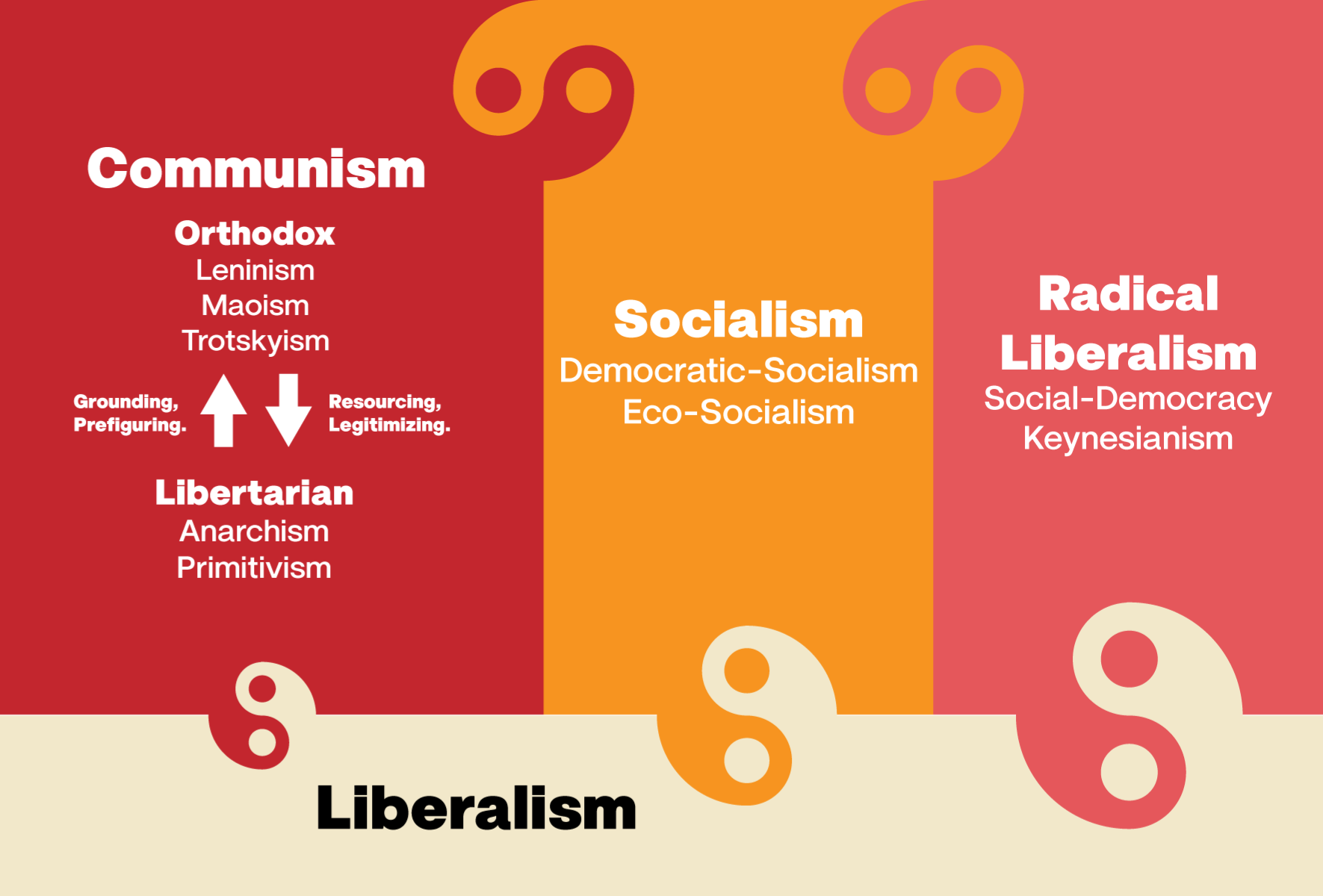
Above, you will find a graphic I made to visualize the left’s ideological ecosystem. It portrays liberalism as the soil out of which the left grows, because as painful as it is to admit, most of us start our political journeys within the confines of the USA’s Overton window.
At each ideological interface (represented by yin and yang), there is a relationship between the more radical elements and the more moderate ones.
It’s important to have a lively moderate wing in a political movement, because the moderates will have the easiest time presenting the left’s most popular ideas to the rest of society. The moderates will have an easier time reaching outsiders, and can bring new people in who might then develop their critiques further and become more radical.
It’s just as important to have healthy radicals in a movement. They create spaces for intellectual curiosity where new ideas can be formulated and tested. They push the moderates to adopt more ambitious political goals, and can force political opponents to accept compromises with the moderates (lest the radicals take matters into their own hands).
What matters most in a healthy ecosystem is relationships. Different parts of an ecosystem have to be interacting for energy to flow through the whole system. The more these parts disconnect from each other, the weaker the whole ecosystem becomes.
The American left has a very unhealthy ideological ecosystem, largely because we are so disconnected from each other. Many liberals are doing their best to alienate their left flank, and leftists have responded in kind by rejecting even the possibility of a coalition that might include the most progressive Democrats. You can see this disfunction in so much of the online discourse we participate in. The way some liberals conspire with conservatives to demonize leftist figures like Hasan Piker. The way some leftists deny the value of No Kings protests, and write off anyone who attends them. In pursuing ideological supremacy, many of us have decided that there is no value to collaborating with people who don’t share our ideas.
But different perspectives can be valuable, even when you don’t agree with them. Listening to someone else describe their views can help you see blind spots in your own thinking. It can remind you to think about things critically when you had been taking them for granted. Even if you will ultimately remain in disagreement, that difference can become an asset rather than a liability. But it requires us to accept that people who think differently are not defective, rather they are unique.
You cannot talk someone into thinking you are right. If they disagree with you, they are going to do what they think is right, and probably don’t care what you think. If they agree with you, they are going to do what they think is right, so they don’t need to be convinced by you. Most people just do what they think is right, regardless of how other people feel about it. People who spend a lot of time worrying about what other people think rarely do much, because doing something runs the risk of disappointing or angering someone else.
But you can make someone feel like you’re right. You can do that by doing really cool shit that they want to be doing. And if you’re doing something really cool, something that really helps people, something that seems important, something that doesn’t feel like a burden, then people will want to participate regardless of whether they agree with your politics.
And this is a perfectly reasonable principle for organizing a movement. We want the world to be different in some pretty concrete ways. And there’s nothing stopping us from building alternatives to the system we live. There are actions we can take in the present that show people what our values look like in practice. Even small things can become quite important, if it’s something that makes the left seem like the right place to be.
Finding Your Niche
In an ecological ecosystem, biodiversity is one of the most important measures of the ecosystem’s health. This is because each of the unique species in an ecosystem have their own unique role to play, which is also known as their niche.
An ecosystem needs decomposers to turn dead organisms into constituent parts that plants, animals, and fungi can eat to grow. It needs animals that dig through soil to make it easier for plant roots to tunnel down into the ground. It needs plants that can be eaten by animals, and animals that eat the herbivorous animals so that the herbivore populations don’t overwhelm the plants. All these disparate parts work together to ensure the health of the ecosystem as a whole.
This is also true of ideological ecosystems, although the niches look different. I won’t list them all here, because I don’t know what they all look like. But you can probably imagine them. Think about everyone who considers themselves to be on the political left. Think about all the different things they are doing. Some are organizing phone banks to call representatives. Some are organizing workplaces. Some are illegally gardening in the middle of the night, or feeding the houseless, or creating content, or delivering aid to Cuba and Palestine. All of these are different niches that people feel naturally inclined to inhabit.
Something you will never see in a healthy ecological ecosystem is plants or animals debating with each other over which niche is the best, or the correct one. In a world where every organism could communicate with each other, you would never see trees criticizing worms for spending all their time below the soil surface. What would it mean for us to engage with politics in the ways that feel natural to us, where we are intrinsically motivated to participate?
As people do the things that come naturally to them, they find others who want to do the same things. When their efforts combine, they are able to achieve more. When they have an unmet need, they build relationships with other people, or other organizations, and fill that need with a new relationship. As more relationships are built, many small organizations can build a coalition, or even a movement.
Instead of trying to prove that we are right, we should instead strive to be effective. We should strive to live our values. It’s still important to engage with the intellectual aspects of political organizing, but there are more productive ways to go about it than fetishizing debate and asserting the eternal truth of ancient theories. As Marx said “the tradition of all dead generations weighs like a nightmare on the brains of the living.”
This is one of the most useful lessons I’ve learned from Buddhism. At its core, Buddhism is a philosophy built around the idea that living a good life requires living in the moment. This is why meditation is a core practice in Buddhism, it’s a practice that makes you pay attention to the moment without being bogged down by thoughts and ideas. When you pay attention to the present, to the world that is happening to you, and to the way your mind and body react to the world, you get better at noticing what feels natural and what feels forced.
And this is what I believe the left is missing. We do so much thinking that we rarely pay attention to feelings. Some of us struggle to notice when we are doing things that feel wrong. And the political projects we participate in tend to feel right. When we recruit new people into our ranks, it’s not because we convinced them to participate in the correct thing, it’s because they felt a sense of alignment that they weren’t feeling elsewhere.
If we approach politics more mindfully, we can get better at coexisting with people with whom we sometimes disagree. Coexisting ideologies make for powerful movements. It changes a movement from an octagon full of bloody fighters into a hallway full of open doors. It invites us to help people find their niche: the organization doing what they want to do, or the ideology saying what they want to say. When a comrade moves on to another organization or another cause, this becomes a victory rather than a defeat.
When people are empowered to move freely between the different organizations in a movement, they are more likely to find their political home, the place where their organizing feels fruitful and organic. It allows people who are burnt out on one type of work refocus their efforts elsewhere. It helps new people see that even if they have a bad experience with one organization, there are other organizations worth trying, allowing them to flow into the spaces where they are needed.
An Irresistible Invitation
A coworker once told me something that completely reframed my approach to political organizing. We were discussing the upcoming election back in 2024, and I was lamenting the fact that there seemed to be no good options for how to engage with that political moment.
She told me “movement building can’t feel like a grim duty, it has to feel like an irresistible invitation.” I heard this around the time I was first exploring Buddhist philosophy, which certainly felt like an irresistible invitation. As Buddhism and specifically meditation became an important part of my life, the truth of her statement stuck with me. As my practice allowed my conceptual mind take a backseat, it became easier to see the difference between grim duties and irresistible invitations.
We are social animals who crave community as much as we crave food, water, and shelter. We are imaginative animals who are so talented at thinking in abstractions that we often mistake our thoughts for our reality. If we hold ideas too close to heart, we can get lost in them. If we hold ideas that change us into combative, vindictive, or cynical people, we may benefit from letting those ideas fall away, for the sake of community, and for the sake of coalition.
Thich Nhat Hanh, a wonderful Buddhist philosopher, once predicted that “the next Buddha will be a Sangha.” In Buddhism, the Sangha is any community of Buddhists who practice together. What he was saying in this prediction is that the next wave of enlightened thinking will come from communities rather than individuals.
This is almost certainly true in politics too. The next great revolutionary will probably be a community. It will be a group of people who build something compelling that crosses ideological boundaries. It will be a group with new ideas about how to make coexistence productive.
Ideology is a tool, not an identity. Every ideology has something useful to contribute to the broader conversation on the left. If we let ideology rule our interactions, we risk alienating each other, and especially those on the outside whom we need most of all. If we focus our efforts on building an alternative vision for how the world can work, and in doing so live out values that draw people in, then we can win.
BACK TO BLOG